







How a 1960s Microfiche Machine Saved the Day for a Kubota Owner
Tags : kubota-landing |At Messick’s, customer service is at the heart of everything we do. Whether it’s finding the right part, troubleshooting a machine, or digging deep into our resources, we go the extra mile. Recently, Lynn Anderson from our call center helped a customer in a way that showcased just how valuable old-school tools can still be. His secret weapon? A microfiche machine—technology from the 1960s that ended up being the key to solving a modern-day problem.
The Challenge: Finding the Right Part for a Kubota M4500 DT
A customer called in needing bearings for the front axle of a Kubota M4500 DT. When Lynn pulled up the tractor’s information in our system, he quickly realized that only two part numbers were listed—far fewer than the number of components actually present in the axle assembly. Without a complete list of parts, the customer was stuck.
Determined to find a solution, Lynn turned to a resource that many would overlook: the microfiche machine. This decades-old piece of equipment holds detailed parts catalogs that predate modern digital systems, offering insights that aren’t always available online.
Turning to the Microfiche Library
Messick’s maintains an extensive library of old manuals, diagrams, and microfiche records—because you never know when they’ll come in handy. Lynn knew that if the missing parts weren’t in the computer system, they might still be available on microfiche.
He located the microfiche film for the Kubota M4500 DT, loaded it into the machine, and began scrolling through tiny, film-based records. Sure enough, he found the full diagram of the front axle, including the missing bearings with their part numbers.
Why This Matters for Equipment Owners
This experience highlights an important lesson: even in the digital age, older resources can still be invaluable. Manufacturers often stop publishing certain information online, but that doesn’t mean the parts no longer exist. At Messick’s, we don’t throw anything away because we know that historical records can be the key to keeping your equipment running.
A Commitment to Customer Service
Lynn’s dedication to problem-solving is just one example of how our team goes beyond the basics to serve our customers. We don’t just look up part numbers—we take the time to ensure you get exactly what you need, even if that means dusting off a tool from the past.
So, if you ever need help tracking down a hard-to-find part, give Messick’s a call. We’re here to help, whether your machine is brand new or decades old.
More Articles

Kubota 50 Hour Maintenance on LX3310
Neil from Messick's here to do a little bit of tractor maintenance with you here today. This is my Kubota LX 3310. It's not just a pretty tractor for YouTube videos, I actually do a lot of work at home with it. I'm rounding about 50 hours, 50 hours is a meaningful service interval for your equipment. It is the break in interval, and you're going to go through and drop fluids from your engine and transmission at this point, spin some new filters on there in order to get out all of that initial break in stuff that happens when a machine is new. When those gears first start turning, there's a lot of wear that happens there initially. It's probably the most important service interval that you're going to do. So today we're going to do it on my tractor here, go around and check a couple of different service points and change some fluids. Now before we get started, this should not be the first time that you're servicing your tractor. If you have a loader or a mower deck about every 10 hours you should be hitting those things with a grease gun, going around greasing all the moving points on your loaders and your mower decks. That is one of the primary things that we will look at when we see where on a machine.

Upgrade your tractor with Rubber Floormats. Kubota L2501 L3301 L3901 L3200 L3800
Kubota recently introduced to the 02 series of the Standard L, the L 33-02, and the L 39- 02. When new models are introduced, they don't break the mold from the old one and completely change it around. And so we're able to go through the parts catalogs for this new model and try to find some of the improvements that can be carried back into the older machines. Today, we're going to show you the rubber floor mats from the L O2 and install them onto an L 25-01 tractor that I have here today. So, why rubber floor mats? Why do you want to consider doing this in the first place? There are a couple of reasons why these are considered a little bit more of a deluxe feature, or deluxe option, on some tractors. When you look at economy-oriented machines, you're usually going to find a simple metal floor pan like this. It does the job. Right? It gives you a place to step. The little holes here kind of create some slip resistance, but rubber floor formats are usually considered a better alternative for a couple of reasons. There are a little bit more anti-slip. These little pop-outs that are put in here will give you some traction for your boots, but a rubber floor mat is going to do a better job of that. They also help with keeping the noise down. These heavy, rubber pieces. They don't resonate.
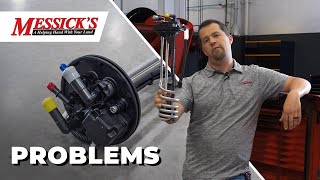
DEF problems What is the DEF header and how its been improved.
This is a DEF header, and this part is responsible for a lot of headaches in our shops throughout the last number of years. I'm going to show you here how a DEF header works, how the manufacturers have improved the construction of these things over the years. Hopefully we could take a little bit of education here today and prevent you from having trouble with your DEF equipped equipment. Now, while this thing looks pretty complicated, when you start breaking down its function there's actually a lot of simple parts here that you can understand within this one large assembly. This coil that comes down here through the yellow and the gray caps is a heating element.
You're going to have a pump and a heater up here that pumps warm fluid down through this coil in order to warm DEF fluid up. It can freeze in the wintertime when it gets cold, and so this is going to help heat the tank up to keep the fluid flowing freely. The other lines here are going to dip down into the tank itself. There's one line right here that comes up to the quality sensor, that we'll talk about later, a vent line here in the top, and then an intake line to pull the DEF up, and then out into your exhaust system. This plug here at the top is for the quality sensor. That's this box that sits on top of the assembly right here. It measures that the DEF has the right proportions of the different ureas and waters inside of it that help it work properly. This silver pin right here that runs right down through the middle, if I flip this upside down you'll see there's a float on here. That is the level indicator for the float in your tank. This one assembly right here performs all of these functions. The heating, the dipping, the monitoring of quality, the measuring is all done by the DEF header.